
The Truth About Customer Acquisition and Digital Marketing for Self-Storage Facilities
What the Data Shows About Self-Storage Customer Acquisition
Digital visibility and local presence are no longer “nice to have” in self-storage -they are the foundation of growth. Across the industry, operators report that organic website traffic and drive-by visibility still account for the majority of new rentals. Storage Commander’s 2025–2026 Operator Survey found that nearly 80% of customer acquisition stems from these two areas alone, supported by ongoing studies from CBRE and Modern Storage Media confirming that search and drive-by awareness remain the industry’s most consistent demand drivers. But while the basics of being found online and seen in the community remain critical, competition and customer expectations are changing fast. Digital marketing for self-storage facilities is becoming essential. The best operators are no longer relying on one or two channels -they’re diversifying their outreach to ensure steady lead flow, better conversion rates, and stronger tenant retention.
What the Data Shows
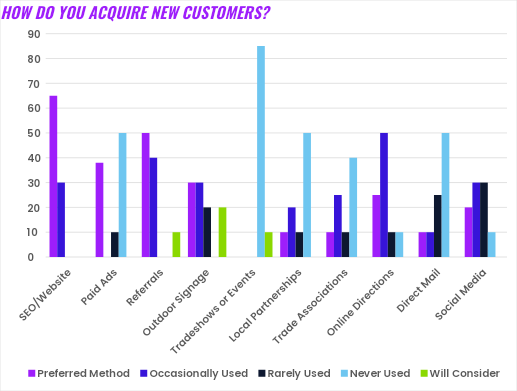
Storage Commander’s research asked operators to rank how they acquire new customers. The results paint a clear picture of evolving marketing priorities:
- 67% of operators named SEO and website visibility as their preferred method.
- 50% rely on referrals as a steady, trusted source of new tenants.
- 30% consider outdoor signage an important part of their acquisition mix.
- 38%
use paid ads at least occasionally to boost reach or fill seasonal gaps.
The Power of Being Found – Your Website
Customers today expect instant access to storage options, pricing, and reviews -often without ever picking up the phone. That means your digital storefront must be as strong as your physical one. Many organizations have free or low-cost websites that were designed during the pandemic and are not optimized for AI search, PCI compliance, or user-friendliness. At minimum, a well-optimized website should load quickly, rank high in local search results, and integrate with your management system. Operators investing in these fundamentals continue to see a steady return. In fact, the gap between facilities that maintain strong SEO and those that don’t is widening -not just in occupancy but also in customer satisfaction and renewal rates.
Local Reputation Still Matters
Even in a digital-first world, community trust drives decisions. Word-of-mouth referrals remain one of the most efficient acquisition tools because they convert at a higher rate and cost less than paid channels.
Half of survey respondents credited referrals as a consistent source of new customers. Many organizations combine formal referral programs with effective review management strategies, encouraging tenants to share their feedback and experiences online. Local signage also continues to play a role -especially for facilities near high-traffic corridors or neighborhoods. For many potential tenants, the combination of seeing a recognizable sign and recalling a positive online review builds credibility before they even click “reserve.”
Paid Ads and Social: The Supporting Cast
While digital ads and social channels aren’t the top performers for direct conversions, they play an important supporting role. About 38% of operators use paid advertising -often seasonally or to fill vacant units in competitive markets. Google Ads, social display campaigns, and retargeting remain cost-effective when paired with strong SEO and a mobile-friendly website.
Social media’s value, on the other hand, lies in brand reinforcement . Platforms like Facebook, Instagram, and Nextdoor help operators stay visible in local conversations, share community involvement, and humanize their brand. Though they may not drive as many rentals directly, they nurture trust and awareness that pay off over time. We call this the “halo effect”.
Why Multi-Channel Marketing Wins
The data underscores a key shift: single-channel marketing is no longer enough. Operators who blend digital visibility with community engagement outperform those who rely solely on one method.
For example, a facility that ranks well in search, maintains a clean and visible property, runs occasional paid ads, and encourages tenant referrals is more likely to sustain occupancy through market fluctuations.
This balanced approach also helps offset risks. When search algorithms change or ad costs spike, community engagement and referral programs provide stability. Conversely, when local traffic slows, digital tools keep leads flowing. In short, diversification is the new insurance policy for occupancy.
Retaining Customers: The Other Half of the Equation
Here’s an interesting fact – it may only cost $200 to $300 to acquire a customer, but if you factor in lost rent over time and other expenses, the loss of a customer could be thousands of dollars. Acquiring customers is only part of the story. Retention -keeping tenants longer and encouraging positive reviews -is where profitability lives. Operators who communicate proactively, simplify payments, and use automated reminders are more likely to retain tenants beyond initial lease terms. Loyalty programs, flexible billing, and strong digital communication tools (email, text, and mobile apps) create convenience that customers remember.
As competition increases, experience becomes a differentiator. Facilities that make renting, paying, and moving out seamless will retain more tenants -and win more referrals -than those that rely solely on price or promotions.
Key Takeaways:
- Digital visibility and SEO are essential - 67% of operators depend on them as their top acquisition channel.
- Referrals remain powerful , reflecting the importance of reputation, service, and community engagement.
- Signage and local awareness still drive in - person conversions, especially for smaller markets.
- Paid ads and social media work best as complements , not replacements, for organic reach.
- Retention matters -
happy tenants drive repeat business and new referrals.
The Bottom Line
Digital visibility is now table stakes. SEO and local optimization continue to deliver results, but working across multiple channels -from search and signage to referrals and social -is becoming the true differentiator for operators looking to stand out in competitive markets.
To explore how top operators plan to grow and adapt in 2026, download the full Self-Storage Industry Outlook: 2025–2026 Market Research Report from Storage Commander. It’s packed with data, insights, and benchmarks to help you shape your strategy for the year ahead.